Forward to a quarterly “book reports” schedule… I started writing these book report blogs in October of 2022, with the intention of putting out one every quarter. It didn’t quite work out that way, but now I’m syncing up the correct rhythm and here I am with another one right on time. The books I have read most recently are:
LAST CHILD IN THE WOODS
BY RICHARD LOUV

Upon first look, I felt like just reading the cover told me everything I needed to know already. I mean, it’s a pretty powerful concept and I didn’t need a lot of convincing to know that our children will benefit from getting out in the woods more often. But then, getting into the thick of it made me realize there was a lot more under the surface. At first, it read like a lot of doom and gloom: negative environmental portents combined with negative health & psychological predictions for America’s children. But, later on the book turned to solutions.
This was an extremely interesting topic for a book, made a bit less interesting by the “list of things” format. Most of the time he was just referring to other people’s work in a monotonous litany of facts. Most of this book was a thorough analysis of the problems: environmental degradation, habitat loss, pollution, climate change, disconnection of children with nature, increase in ADHD and other neurological disorders amongst children, too much screen time, communities that devalue nature, too much concrete, sanitized environments, a litigation culture that stops children from playing in nature, homeowner association rules that curtail natural environments and natural play, loss of forests & pasture to urban deserts, soil loss, and more…
As an aside, there was a point in the middle of the book where I found myself reading about a friend of mine. It was definitely him, no mistaking. So, I called his son (another friend of mine) and he told me, yeah, the author and his Dad were old friends and he’d been written about in this book. That was a cool little “Easter egg” in there for me.
Then the book turned to solutions, and this was the part that really excited me. These were the ecologically optimistic futurist visions that I share with the author, and love to elicit in others when I can. I got very excited about the book at this point. I loved the solutions, including: the new back to the land movement, the spiritual necessity of nature for the young, building a movement of social norms, education & legal reforms, and community design. At this point I shared the book with several of my friends as a reading reccommendation.
One of my friends who read the book surprised be my disliking the entire “solutions” section that I had loved so much, mainly because some of them involved issues of faith (he doesn’t like faith) and government control (he doesn’t like government control). I sympathize with his perspective, but I’m less pessimistic. I definitely agree that there are potentially heavy-handed government policies that can create a lot of bureaucracy and red tape, and force improper solutions on people, leading to even greater problems. However, government incentives and regulations can also be used in more subtle and effective ways to guide the creation of a desirable and beneficial society. On the issue of faith, I believe strongly in the power of faith, and the importance of developing in young people a faith grounded in nature. But, I would caution against any kind of pie-in-the-sky thinking that assumes everyone will just spontaneously take the difficult moral path. Building faith and acting on faith is a hard road.
Shortly after I finished this book, it came up in a presentations during a meeting I was broadcasting at the Skagit County Commissioners office. The discussion centered around Nature Prescriptions, which is something I already use with my fitness coaching clients, and apparently is gaining popularity amongst the Public Health sector. It was a very interesting meeting that showed me how this book, now 20 years old, is still making its rounds and having an effect on government policy in the United States.
THE DOORS OF PERCEPTION
&
HEAVEN AND HELL
BY ALDOUS HUXLEY

This is actually two books in one, written in the 1950s by the writer of Brave New World. Both books hinge off the esteemed author and philosopher’s choice to experiment on himself with Mescaline, a hallucinogenic plant medicine used in traditional Native American rituals in both North & South America. His altered perceptions cause him to go into a deep-dive on art history and psychology, which was fascinating to read, but had me Googling an average of 3-5 references per page that I had no clue about. A reminder that–even though I was a big fan of Huxley in grade school–he went to one of those “good” English boarding schools and I went to a backwoods American public school. There is no parity in the education system.
A very interesting set of books that challenged my perception of perception. I especially appreciated his discussion of, “the non-verbal humanities, the arts of being directly aware of the given facts of our existence.”
CONVERSATIONS WITH RASTAFARI ANCIENTS
BY RAS FLAKO TAFARI

This is a must-read for any student of Ras Tafari and the Rastafari movement in Jamaica (or elsewhere). Bringing together the words of seven foundational elders from the Rastafari movement:
• Ras Sam Brown
• Bongo Watto
• Bongo Isaac
• Incient Pa Jack
• Ras Iriz Clark
• Bongo Poro
• Leonard Howell
The first part of the book consists of interviews with Ras Sam Brown and Bongo Watto, interspersed with some of their important documents, poems, and statements of faith. Then there is a testimony of Bongo Isaac, and a testimony of Incient Pa Jack. A large section of the book is devoted to a transcribed interview with Ras Iriz Clark, describing the visit of His Imperial Majesty Haile Selassie I to Jamaica in 1966. Then there is an account of Bongo Poro, the first Nyahbinghi priest, and a short biographical sketch of patriarch Leonard Howell, along with an excerpt from his book “The Promised Key”.
I read this one in the process of recording an audio book for Wisemind Publications, which can be found on YouTube and is also linked from the Audio Books section of my website.
THE RASTAFARI REFERENCE LIBRARY
VARIOUS AUTHORS
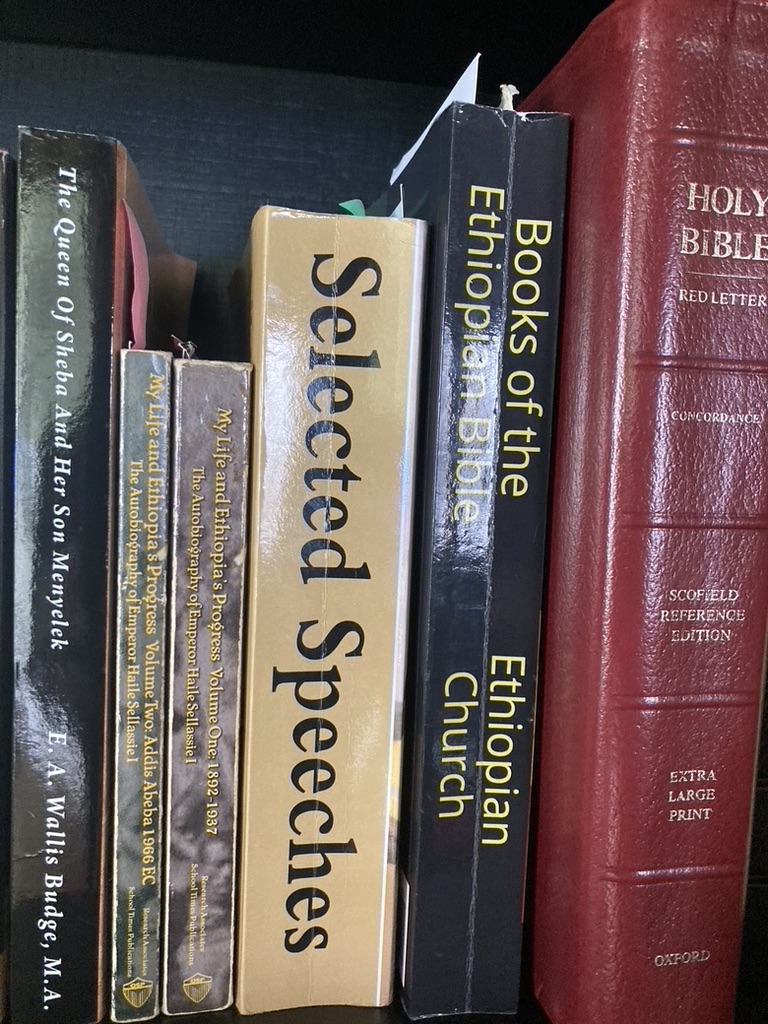
I did not read any of these books cover-to-cover this quarter, but they are the “always reading” reference books that sit on my shelf and come down frequently. I was recently put in touch with an Ethiopian priest in the UK who does an online Bible Study class, and he sends daily readings which I have done my best to keep up with (usually from the red Bible on the right). The deuterocanonical books, “Queen of Sheba…” (a.k.a. the Kebra Negast), and “My Life and Ethiopia’s Progress” are frequent reference points whenever a thought or discussion sends me for a refresher on those critical pieces of history. “Selected Speeches” is the book we read in the biweekly meetings of the International Development of Rastafari (IDOR) group, and I also read it frequently on my own for personal edification.
I was first exposed to the Bible as a child, and I took some great lessons from it, but it was not really an important book to me until my mid-20s, and I was quite unfamiliar with most of its content before that point. That’s when I began studying the Bible in depth in an effort to discover who was this man Haile Selassie I and where did he fit in with God and Christ and the history of the world? I picked up “My Life and Ethiopia’s Progress” as well as “Selected Speeches of His Imperial Majesty Haile Selassie I” shortly after, around my late 20s, when I wanted to discover what Haile Selassie I himself taught about who he was, who was God, and Christ, and what were we as human beings (particularly his followers amongst the Rastafarians) supposed to be doing with our lives on this Earth? These books continue to provide me guidance in that regard and never disappoint.
 Nic Nakis