
Baby’s First Train Ride
Ok. I can’t really call him a “baby” anymore, Nathan is 7 years old and entering second grade… and, it isn’t technically his first train ride, Nathan rode the train when he was a baby in Kenya and Germany. But, he doesn’t remember any of that, so this was like his first official train experience that he will remember and enjoy. Please let me get away with this title.
Now I bet you’re wondering where we’re taking the train to? We’re on the way to Daghim’s wedding in Portland. Daghim is a Deacon in the Ethiopian Orthodox Tewahedo Church. He comes from Ethiopia, and we have been friends pretty much as long as he’s been here in the USA serving at our parish in Lynnwood, Washington. He is an intelligent and honest young man, dedicated to his office, and wise beyond his years. I was quite honored to be invited to his wedding. Chelly had a catering event this weekend, so it would just be me and the boys for this one.
We decided to take the train because… well, why not? A train is a beautiful way to travel. You don’t have to drive. You can watch the countryside go by. You can get up and walk around or take a nap if you want to, read a book, get some work done, eat a meal. It’s one of my favorite ways to go and I thought the boys would like experiencing it. So, we drove to Northgate Station, parked the truck there, took Seattle’s Link Light Rail downtown to Union Station, walked across the street to King Street Station, and hopped on an Amtrak to Portland.
Train rides are fun, and there’s something I find very exciting about leaving town and going somewhere else, but the boys were split in their attitudes about it. Javan is 13 now and he just wants to be contrary to everything. No matter what the plan is, he’s not into it. So, he separated from us and found his own seat, told me he needed a nap, but really just sat watching videos on his phone the whole time. Nathan, on the other hand, was jumping with joy–literally–he had a hard time keeping his seat. We played card games like War and Slap Jack until I fell asleep, and then he explored the train car making friends with strangers (which, yes, I am OK with, and I consider it good parenting).
While I slept, the AC on the train went out, and I woke up a sweaty mess. The conductors were complaining about it and giving us instructions how to file our complaints, but there was nothing they could do about it and we rode the hot train all the way into Portland. That didn’t bother me much, but it did mean that when we got off the train none of us had the energy needed to haul our bags around town and find a restaurant to get dinner. So we took an Uber to our hotel in the suburbs and got our dinner there at a brewery/pizza place that was showing the Olympics on TV.
After a dip in the pool, it was time for bed, but it was really hard for any of us to get to sleep. There was a lot of excitement buzzing through me and the boys. The train! A hotel! A wedding! But, with a 4am wake-up alarm waiting for us, we just had to stuff our heads under the pillows and get as much sleep as we could.
Pray, Party, Eat
These three words are my simple summary of African culture. It seems to be the same whether we’re over here in the States or over there on the Continent, and whether we’re with the Kenyans, Ethiopians, Gambians, Ghanaians, or even Caribbeans. First we pray, then we party, then we eat. Then we repeat! This Saturday we went through a full four rounds of this and it was the best.
It started with an early AM Uber, 4:30 AM to be precise. This got us to the Church before the bride and groom arrived, so we didn’t miss a beat. These Ethiopian church weddings start before sunrise, beginning with prayers of preparation as the Priests and Deacons open the doors, turn on the lights, and begin to pray over the implements to be used in the service. Believers file in slowly, remove their shoes, and say their own prayers to make themselves ready.


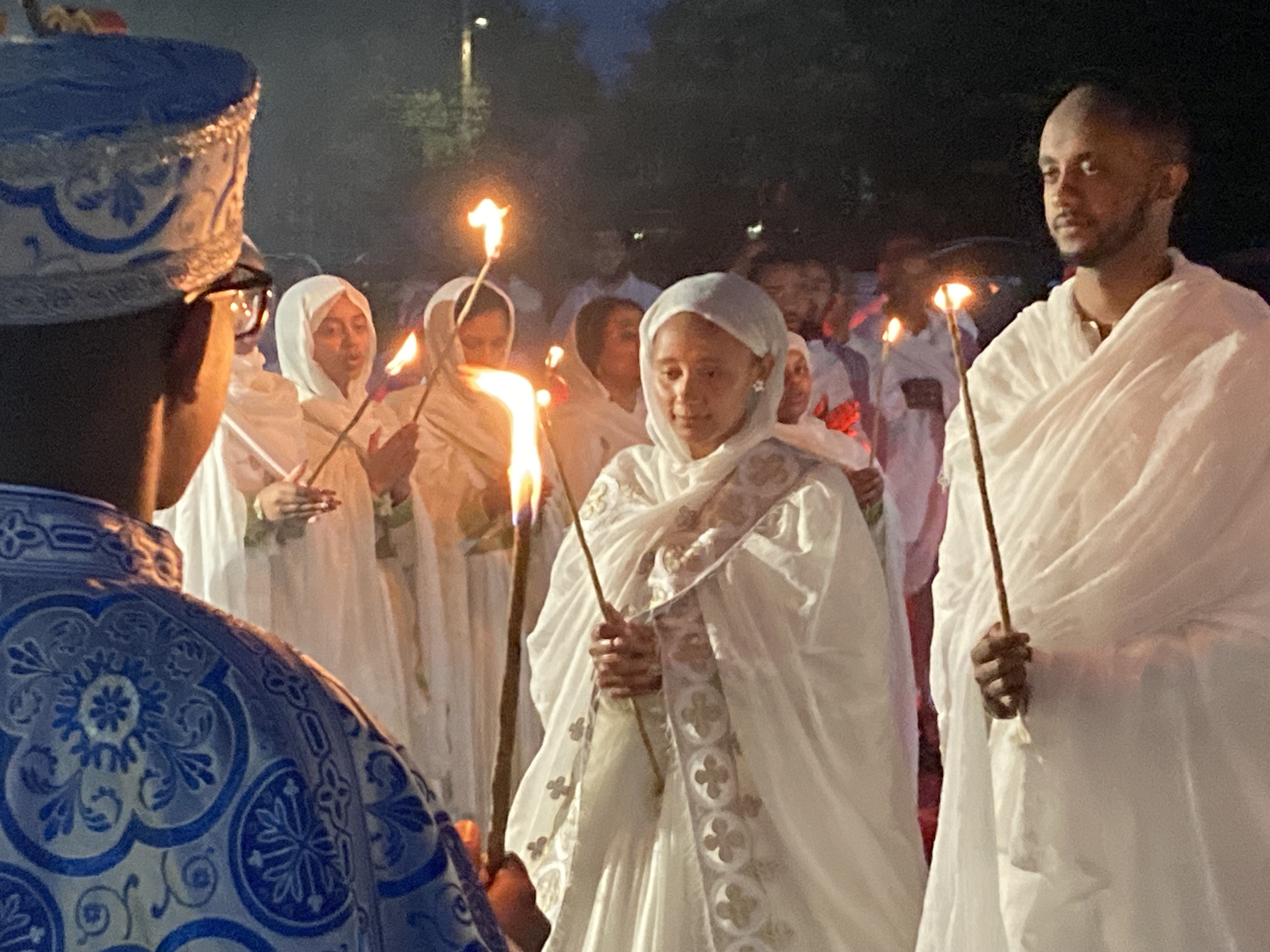
In the parking lot outside, the bride and groom are greeted by a large crowd dressed all in white, some holding taper candles made of bees wax. Amongst them are a choir who sing praise songs and beat drums to welcome the couple. They are celebrated in song for maybe half an hour before being ushered into the building with more music.
Inside the Church, the first part of the service is actually the wedding itself. Solemn marriage vows are made, prayers of blessing are said, and the couple are formally united into one flesh, symbolized by the donning of robes and crowns. This recognizes the couple’s dignity of Kingdom and Queendom as little Christs, exemplified today in the glory of their marriage.


Following that is the Qedassie, the Communion or Eucharistic ceremony. I love this part. This is when we confess our faith as a group, when we confront our own shortcoming within the liturgy, acknowledging our own sins and recognizing the efforts of our Savior to redeem us. This part is mostly a matter of standing and intoning chants or prayers, led by the Priests in a call-and-response fashion. The Deacons carry Bibles and Crosses on procession through the room, and the Priests come with incense. Meanwhile, in the enclosed front area of the Church, the Holy of Holies, a solemn ritual is performed away from the eyes of the laity to prepare the sacrifice. This service requires at least two Priests and three Deacons, but on this occasion I counted 2 Bishops, 11 Priests, and I don’t really know how many Deacons because I lost count. Since Daghim is a Deacon, this wedding was like a family event for the clergy, who have served alongside him for years, and are looking forward to decades more of the same.
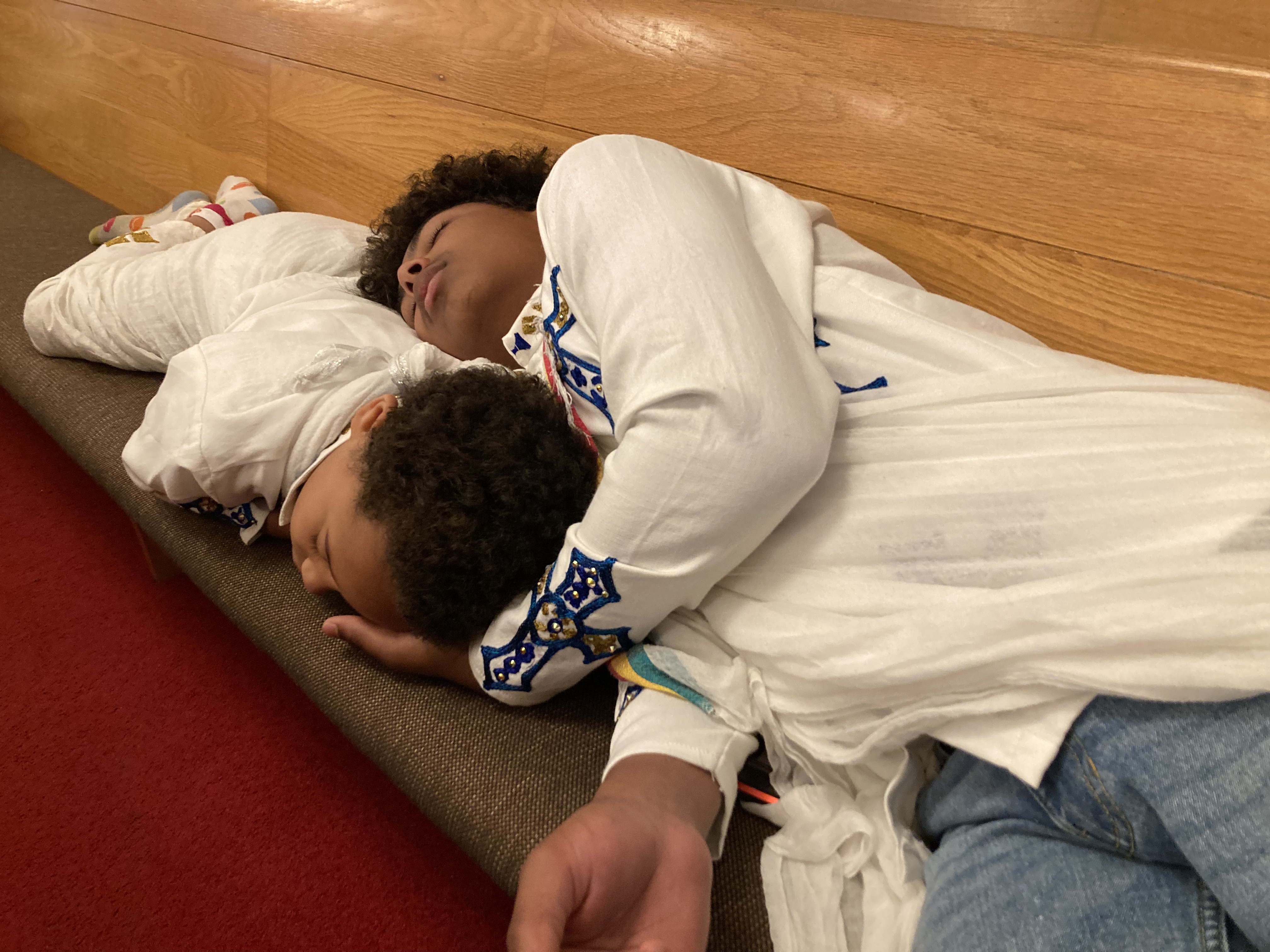
This part is beautiful, but it is also strenuous. Those fasting, or tired, or inexperienced may find themselves sitting down for a while to rest. This is also the part where children fall asleep. And mine did, cuddled up on a pew together in their white shawls. I did too, I have to confess. Looking around the men’s side of the room at various points, I noticed that virtually all of the fathers who had traveled down from Seattle with their families also fell asleep during one part of the service or another. And there is no shame in that. As one of the Ethiopians told me once, the Church is your Mother, and as you slept in your Mother’s womb, you can also sleep in the Church. But we all woke up for the Communion.
Daghim did something very interesting at this wedding, something I had never before seen done. He actually served in his own wedding service. What this means is that he left his throne (thrones are placed at the front of the room for the bride and groom), allowing his best man to take his place there, and he joined his fellow Deacons and Priests in performing the liturgy of the mass, wearing his groom’s robe and crown through the whole thing. Now that the service was at it’s climax, he rejoined his wife to partake of the holy flesh and precious blood. Following them went the little children, and everyone else who desired to commune. The service was completed with more prayers, and then began the partying.
In this case, the “partying” consisted of religious songs and songs praising the bride and the groom. The whole congregation sang and clapped our hands, swaying from side to side. Some songs were accompanied by drums, or the sistrum, or the rhythmic banging of long prayer rods against the floor. At one point, a priest stepped forward to perform Qene, a kind of improvised poetry, playing off of the couple’s baptismal names. With more prayers and more songs, the service concluded. Then it was time for the pictures.

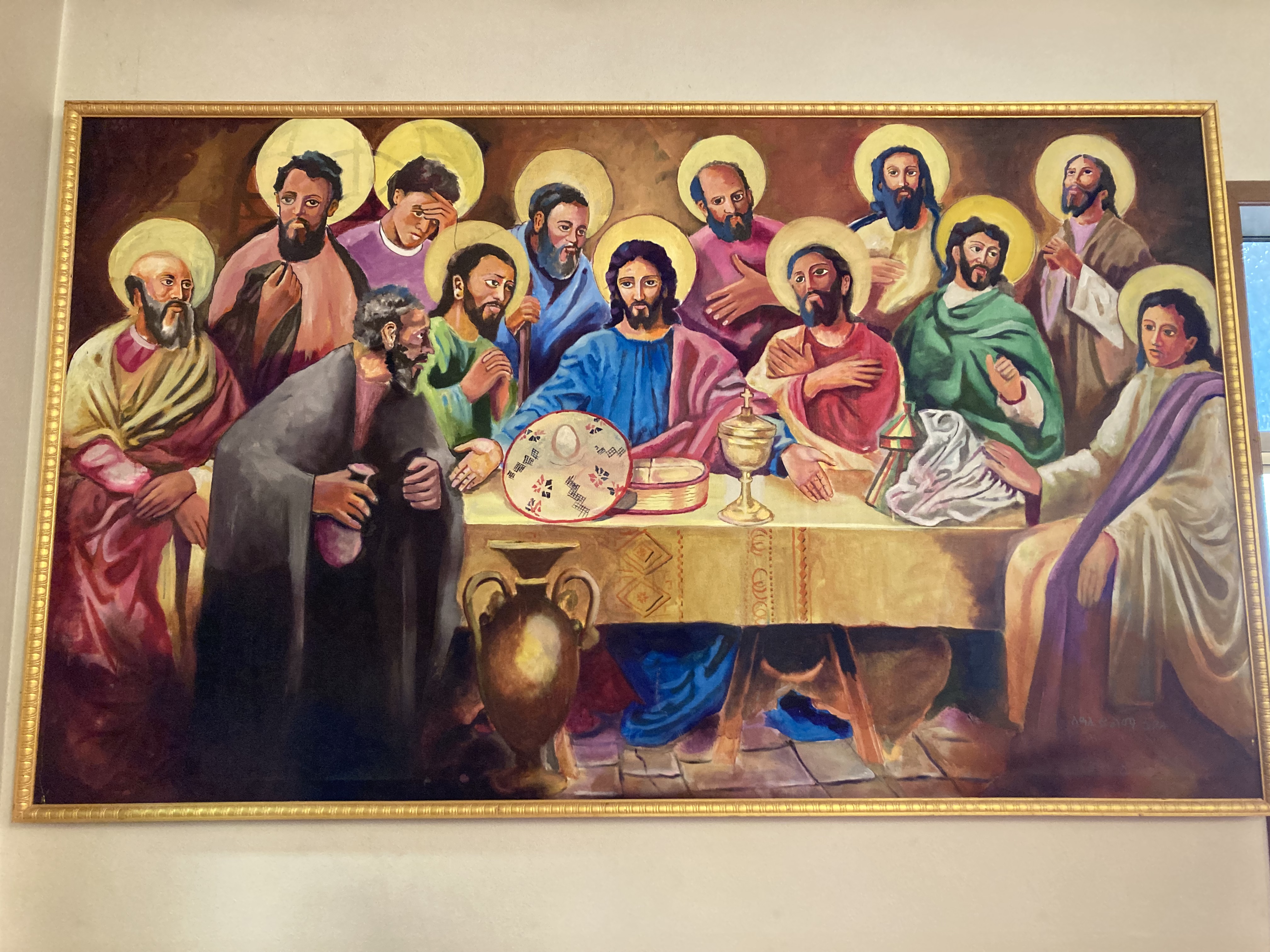
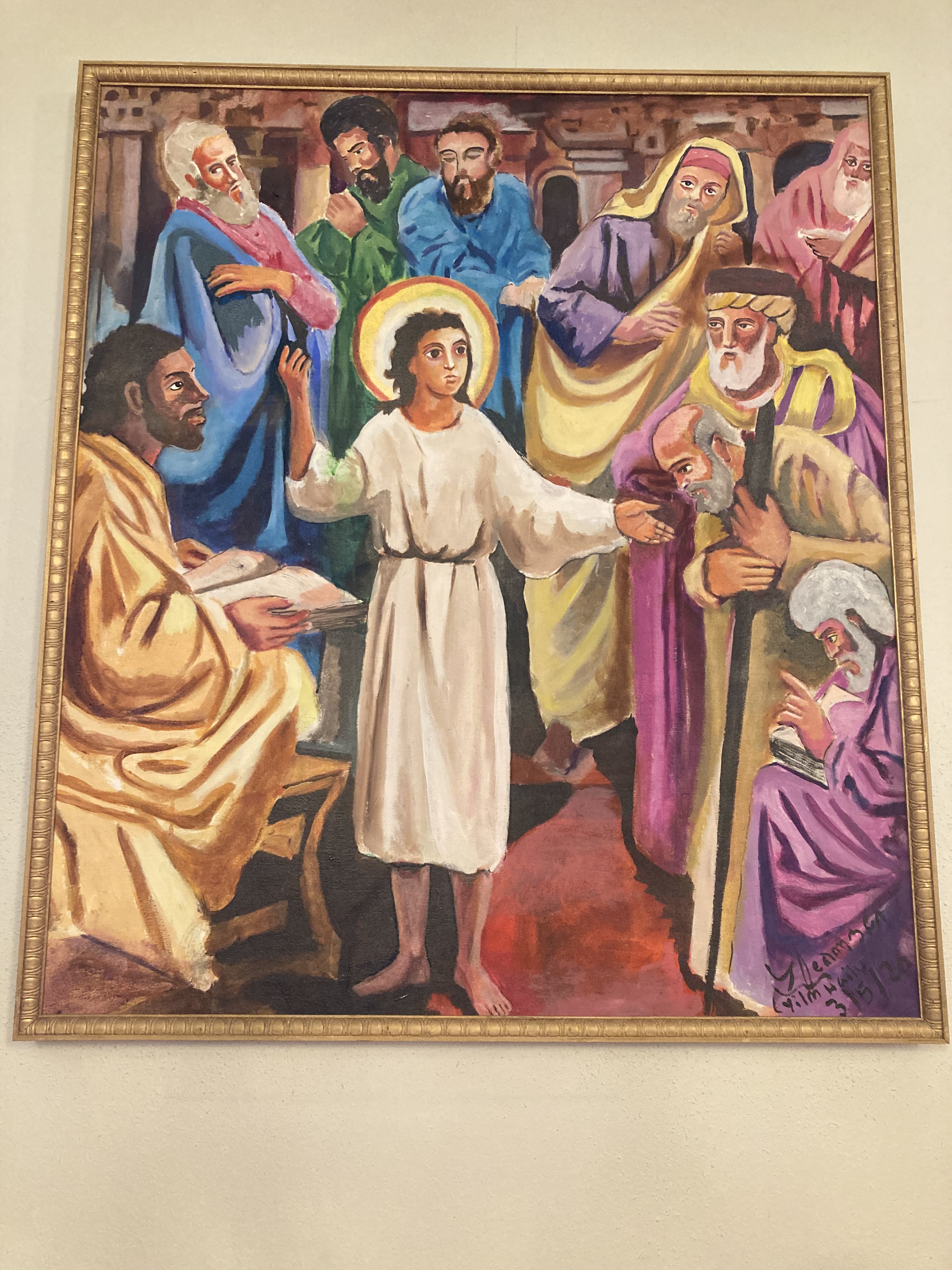
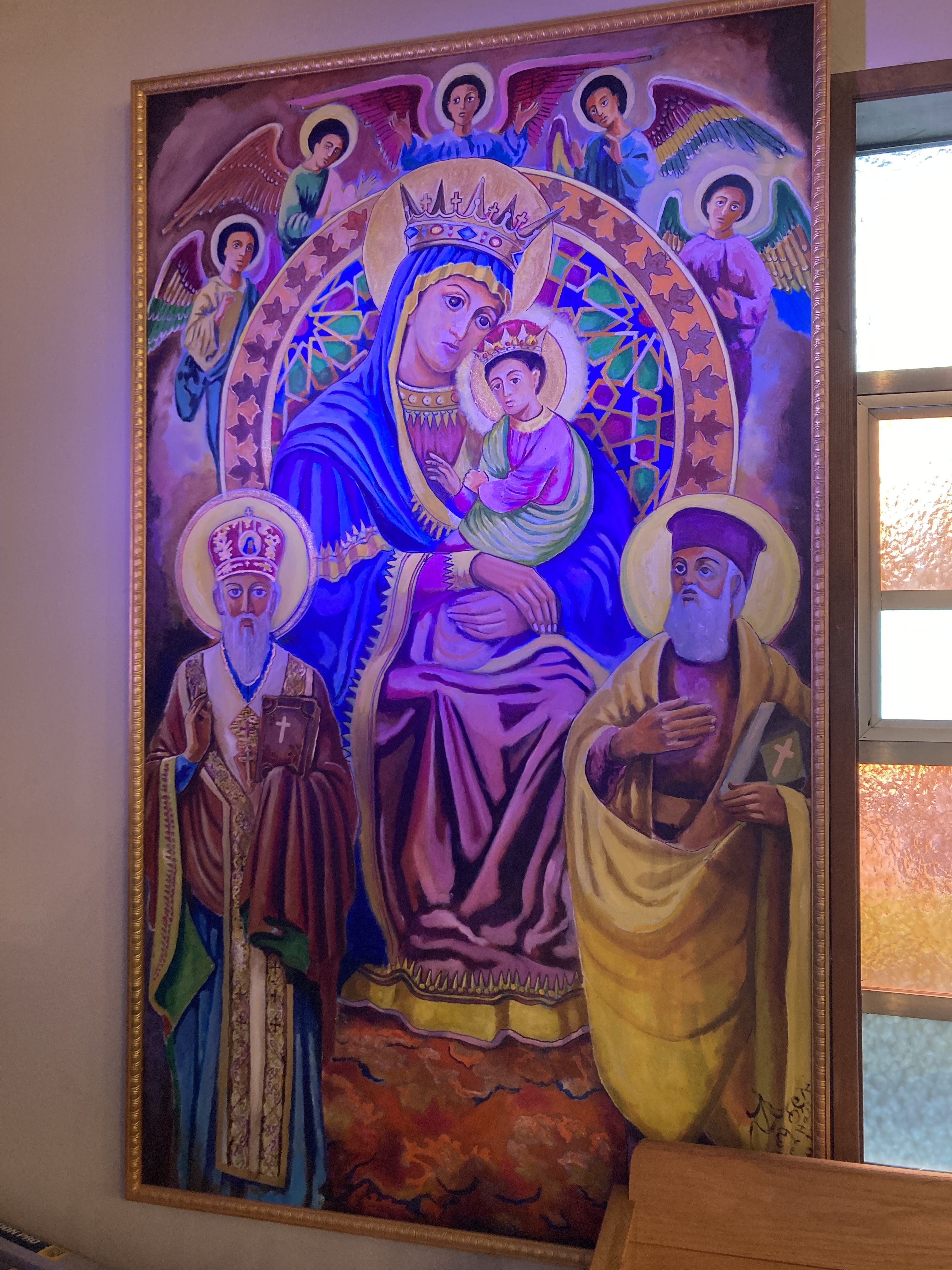
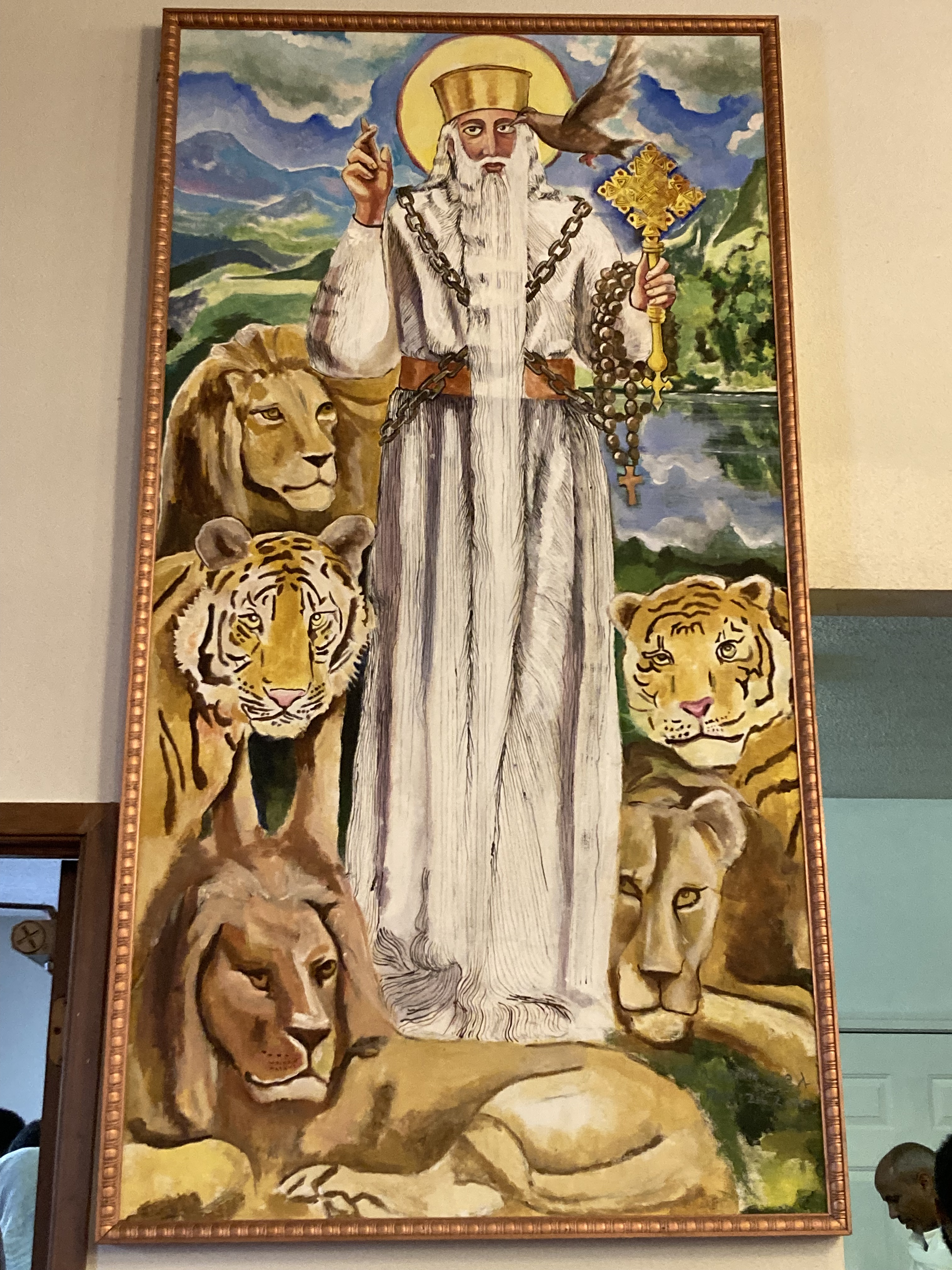
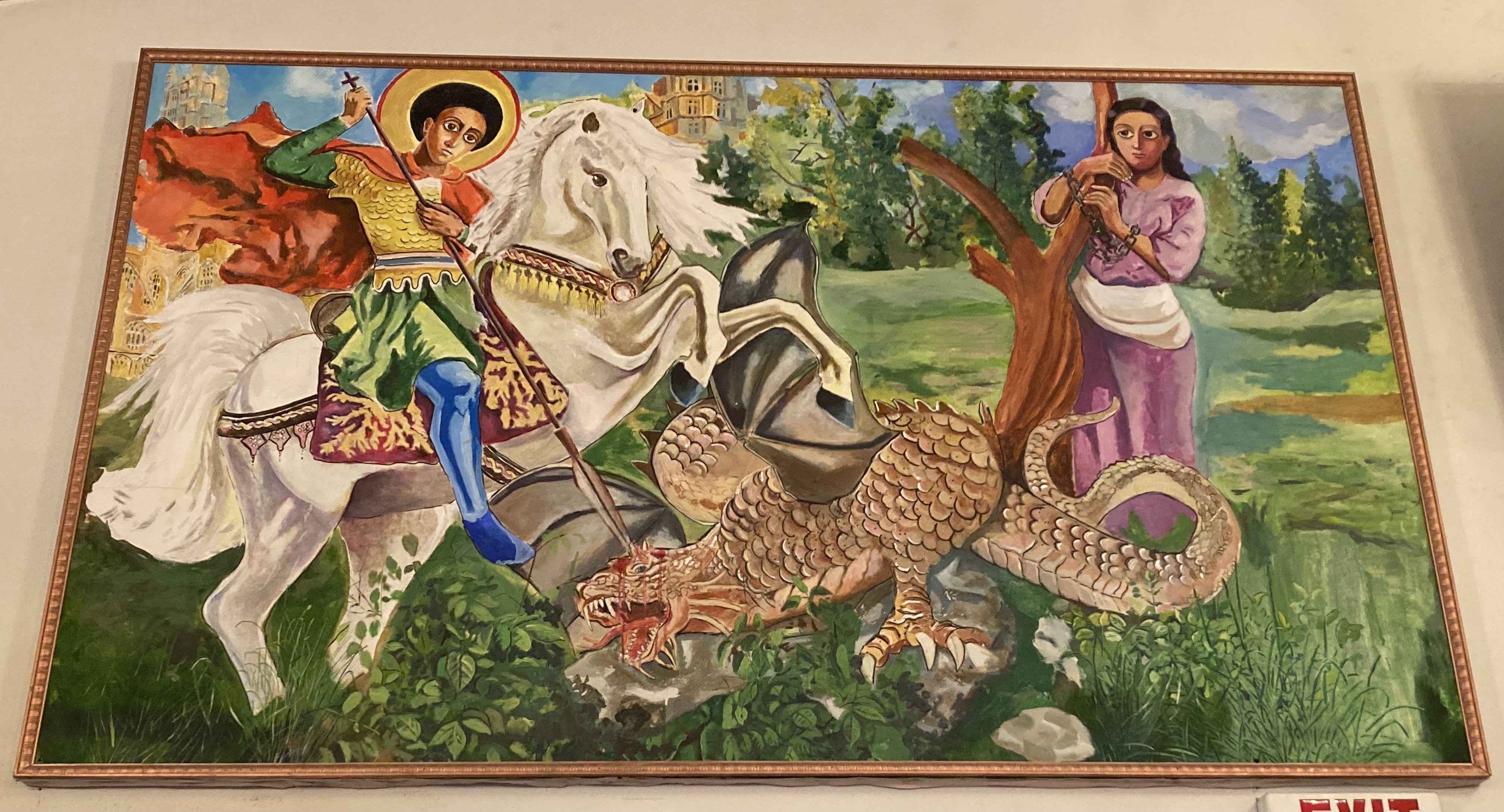
For an absurdly long time, the bride and groom stood at the front of the church before the iconostasis (the wall of icons) as groups of 2 or 4 or 10 came up to pose for photos with them. This part took forever! But, it was so joyful, as everyone wanted their turn–at least once–to pose and smile with the happy couple. I got in there for a couple pictures, and also took this time to take photos of the gorgeously painted icons ringing the room. These were all done by a painter called Yilma Hailu, who paints in a style quite distinct from what I’ve seen before in Ethiopian churches. These were much more naturalistic and almost impressionist in their use of textures, light, and shadow, differing greatly from the flat, traditional style I’m used to.





Then we went down to the basement for a feast! Once the food was blessed by the Bishop, we all got to eat our fill. This was greatly needed because all of the nerves and anticipation, the standing and chanting, the singing and clapping, had taken energy, and we were all feeling very hungry. After all, it was already about noon by this point. We ate and drank and were merry. The children played outside. Grown-ups got a chance to chat, or to watch the kids at play and laugh at their silly games.
It was somewhere between 1 and 2pm when we actually left, and we were told to be at the next venue by 4pm for the beginning of the reception party. Well, that wasn’t likely to happen. We all repeatedly reassured each other of our intentions to be there at 4, meanwhile making plans for the naps, or showers, or trips into town that we’d make during our short break. But the organizers, and all of us, knew that most people wouldn’t show up on time. 4pm was likely the “setup” time, for those who want to help put out tables and things. 5pm might be the “door” time, when people could come in and begin being seated. 6pm was probably the real start time. This is what we usually call “Africa time”, a comfortable buffer of expectations that keeps everything easy going.
Javan and Nathan and I got together with a group of friends, returned briefly to our rooms to change clothing, and then headed into downtown Portland for a little adventure. These friends of ours had never been to Portland before, and I having visited only twice before knew exactly one cool thing to do there: visit Powell’s Books. Our friends were interested too, and I got it into my head to buy some books as gifts for the bride and groom, as well as for the birthday boy we were planning to see on our way home on Sunday. So off we went.
Powell’s Books is the World’s Largest Bookstore, based on shelf space, and the undisputed largest independent bookseller in the world. It has grown to take up an entire city block and is several stories high. When our two families got there we met up with two more. Then we split up into little groups to explore on our own. I went first to the catalog computer to make a list of specific books and topics, then my friend Wende and I headed off.
We went first to the rare books room, where we peeked at some very special publications that were a bit too rich for my blood. Then we checked out the Africa section. I made a stack of books I was interested in, before remembering that I wasn’t there for me, and put most of the books back. I picked out one book of Ethiopian history for Daghim, after thoroughly examining it and deciding that–based on our previous conversations–this was going to be something he was interested in. I also picked up a book for my sons: DK’s ‘The Black History Book’. This is a colorful guide to Black history from ancient Africa until today, helpfully illustrated with graphs and charts and images.


Then we headed over to the Christianity section, particularly exploring the “Eastern Orthodoxy” and “Saints” sections. Now this is somewhere that Wende and I could have spent all day, and almost did. The kids called us several times telling us to come downstairs, but they couldn’t pry us away from those books. Eventually I found one on marriage in the Orthodox church that I thought the bride would appreciate. Then, remembering the birthday party we were headed to on Sunday, I called my friend Joe’s wife to ask her what he might like for a gift. She said, “books”. What kind of books? “Probably ones on Orthodox Christianity. That’s all he wants to read these days.” So yeah, I guess I was already in the right section. I returned to my careful perusal of the Eastern Orthodoxy section and found Joe a carefully curated book of excerpts from the Philokalia, the book of Eastern Orthodox saints’ wisdom.
Then it was time to eat again. It was already 4pm, the time we were told the venue would be opening for the reception, but the boys were all worked up about this famous fried chicken place they’d seen online or heard their friends bragging about or something. And, if we didn’t get them something to eat now, they probably wouldn’t make it until dinner time without whining. We’d only had one meal today anyway, remember? So we took the kids to get some food before driving back to the hotels to change our clothes. Somewhere in there, we passed the very spot where I was beaten up by the police when I was a kid: against the fence surrounding the Pioneer Courthouse. It was a strange experience for me, an awful memory, but also a reminder of just how different my life is now from what it was then.

After dressing up for the party, we met up with our friends in the lobby of their hotel (a short walk away from ours), and managed to make it to the reception hall by 6:30pm, which was still earlier than the bride and groom (see that Africa time at work?). Well, we weren’t quite as on time as we thought we’d be. There were no empty seats left. The massive gathering hall at St. George’s Antiochian Church was packed with tables and those tables were packed with people and now it was standing room only. But that was fine. I had my books to give to the bride and groom and I wasn’t interested in finding a seat until I got that taken care of anyway. I had forgotten somehow the custom at Ethiopian weddings of only giving an envelope of cash, instead of physical gifts. So, here I am standing at the gift table, where there is nothing but a stack of envelopes, a ledger to sign your name and write your gift amount, and a box to drop the envelope in. And there’s me holding two books.
That’s when the bride and groom arrived. Again, like in the morning, they were greeted with songs and drums. During the procession, I approached Daghim and asked him what he wanted me to do with the gifts I’d bought him. Should I set them on the table, or present them to them once they were seated? He said it would be good for me to bring them to him once they were seated. But that took a while. First there were songs and dancing with a big crowd gathered around the bride and groom. I stood up front for all of this, holding my books, backing up slowly as the floor cleared out and people returned to their seats. The bridal party was led to their seats at the high table, and I backed away further to avoid attention at the center of the room. Then the Bishops and Priests made long prayers and speeches. And while they were doing that, a table magically appeared before me. It wasn’t actually magic, but it was cool. Apparently, there were several families waiting in the annex for a place to sit, so the staff brought out extra tables and put one right in front of me. I sat down for the rest of the solemnities, and when the Priests were done, I presented my books to the bride and groom.
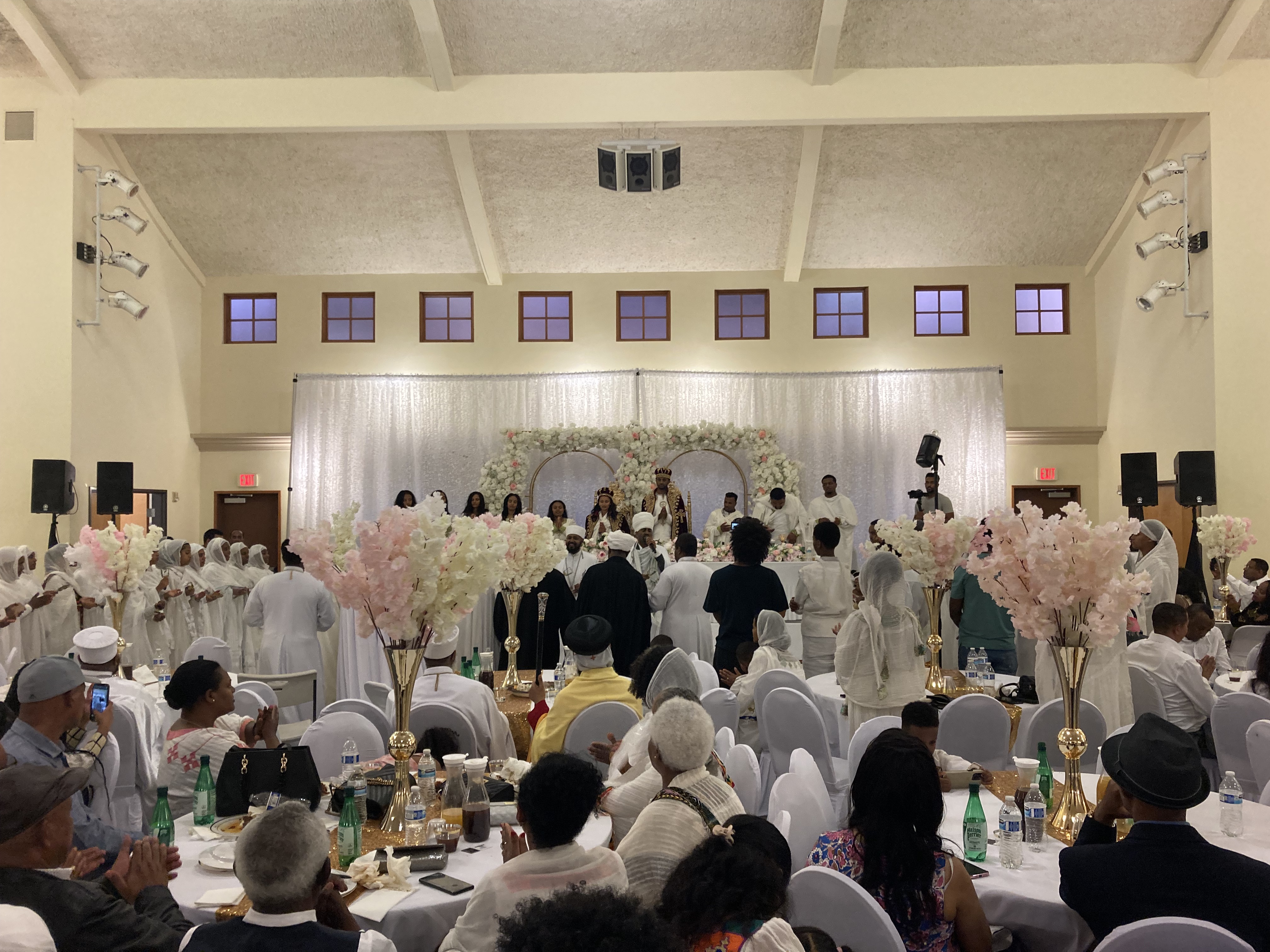
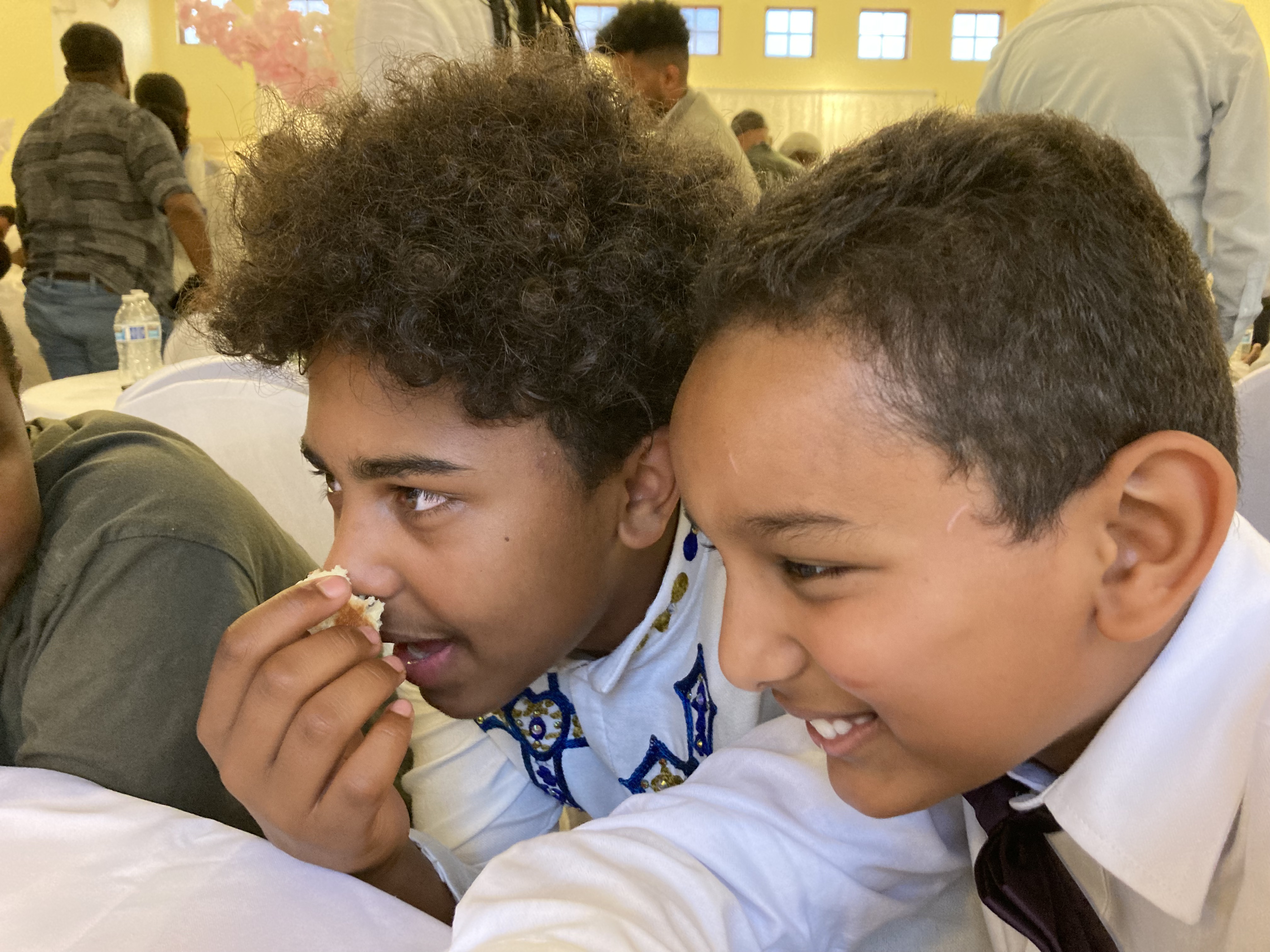
That task being complete, I was pleasantly surprised by my friend Wende grabbing my arm and escorting me to a large table at the back where they’d made room for me and my sons to sit with our friends. We sat with our church-mates from St. Arseima in Lynnwood and shared laughs and conversation while the traditional musicians performed and groups were invited one by one to approach the buffet tables for their food. While we were waiting, we noticed that the children were all staring at phones (theirs or their parents’), watching videos or playing games. A couple of us parents started to murmur and confront the children, “Isn’t there something better you can be doing? You’re with people!” Then we made the collective decision to take the phones away from the kids, and it was great. All the children started to play together, laugh, and tell stories, coming up with different silly games. I hope they will always remember how much more fun they had talking and playing with one another than they did with their phones.
Then it was our turn to eat, filling our plates with all the finest foods that are served at Ethiopian weddings: Injera (of course), Doro Wot (chicken stew with hard-boiled eggs in it), beef stews and lamb stews and greens with pieces of lamb in them, various vegetable stews, Kitfo (spiced raw mince-meat), Ayb (fresh cheeses, some prepared with spices), and my favorite wedding food: Tre Siga (raw beef sliced directly off the cow and eaten with spicy dipping sauces).
We returned to our table, and yeah, then it was just eating and talking. I talked too much, and I took forever to finish eating. Some of our table-mates laughed at me for this, and others were envious, saying, “I wish I could eat that slowly, it would probably be better for my health”. I acknowledge that I took too long, but at least I savored every bite and it was delicious.
Then there were more speeches and prayers, more music, and then it was time to eat again (the wedding cake). The kids ran outside and played all kinds of games on the Church grounds at night, laughing and enjoying themselves. The grown-ups drank a little alcohol (except me, I don’t drink), and laughed and told stories. There was more music, some if it performed live on the Mesenqo (a traditional Ethiopian stringed instrument), and some of it played by the DJ.
Then, around 10pm, it was time to usher out the bridal party. This did not happen quickly. First, prayers. Then, probably some more speeches, I can’t remember. Then, definitely singing and dancing around the bride and groom. Also, there was another long period of posing for pictures with the new couple. This was just like what happened at the Church in the morning, except longer, because there were way more people this time. And after that, more singing and dancing to escort the newlyweds to their awaiting car and watch them drive away.
By now, we were all exhausted. Our day started at 4am, and we never took that nap, but we were wired-up on adrenaline or something, because we didn’t really want to leave. Eventually, I gathered my boys together and we joined our friends and got a ride home to our hotel. The boys needed showers and pajamas and toothbrushes and all that, and we said our prayers and turned the lights out. Still, it was after midnight when we finally stopped chatting with each other in the dark and fell asleep. After such an exciting day, it was just tough to settle down.

The Long Way Home
I let the boys sleep in that Sunday morning. Normally, we’d go to Church. And the Church was not that far away, we knew where it was because we’d been there yesterday. But, with the travel fatigue and the long day and the late night, I wasn’t going to wake the boys up so early to get them ready and go to Church again. Also, there was the whole issue of our 11am check-out time, which would have made for a really hectic morning.
As it was, we barely had time to make it to breakfast before they closed the hotel dining room. We got one last dip in the pool (and hot tub), showered, dressed, packed, and actually checked out a few minutes late (sorry about that, hotel staff). Then we were off to downtown Portland for a little adventure.
I’ve only been to Portland twice before–driven through on a few occasions–but only really stayed and spent time there twice. Once was the time when I was a runaway, as a teenager. Portland was lively then, with a thriving downtown and a lot of people out on the streets everywhere being social and enjoying themselves. The next time was in my mid-30s, when Chelly was pregnant with Nathan. Portland still had a lively downtown then, but the advent of the internet and smartphones had certainly changed the street-life and social norms of the city. It was clean and beautiful, with a lot of great restaurants, and entire parking lots turned into food-truck courts. That’s really what I remember most from that second trip: the food. Chelly was pregnant, right? So we just did a lot of eating, basically, on that trip.
This time was different. We noticed it first on the walk to catch our bus. There were a lot of homeless people. Even here in the suburbs, we stumbled across remnants of encampments and people looking like the walking dead shuffling up the sidewalks. The bus ride was nice and the bus driver very helpful. But, then we got off at the MAX Light Rail station to catch a train. That’s where we saw open drug use on the platform. I told the boys not to watch, but I spotted a hypodermic needle, and Javan said he saw someone smoking a crack pipe. The train ride was fine, but as soon as we got over the river into downtown, we noticed the encampments of street people everywhere.
Let me get something straight, I don’t hate the street people. I’ve been homeless before and spent time on the streets. I still make an effort speak to these people and help them out today. I love them, but while I am not naive about their own role in their situation, I recognize the homeless crisis as a social problem. It is society’s fault. The shame is on those people of a city who allow their brothers and sisters to live in such abject poverty right there in front of their faces. Can they not provide better resources for them? Can they not use the power of their political institutions and commercial organizations (which serve the business community of the city so well), to create jobs and shelter and treatment programs for these people? If not that, can they–as individuals–reach out and help each other in small ways?
Poverty is a social crime because none of these people came into the world alone, they were not born alone, did not grow alone, and did not thrive or succeed alone. Likewise, they did not fail alone. Each of these people has a family and friends who have abandoned them or otherwise allowed them to sink into this desperate situation. To get them out of it will also require social support and cooperation.
So that’s what we saw a lot of on this trip to downtown Portland: homeless camps, and boarded-up shops, and dirty streets, and people sleeping on the sidewalks. It looked rough. It didn’t look nice.
We found a street market and bought some strawberry smoothies, picking up extra snacks to share with a panhandler. Then we wandered off in search of a food truck court. We found one that I remembered visiting with Chelly 8 years ago, but there were not quite so many food trucks these days and it wasn’t looking the best. Nonetheless, Javan loved his Shwarma and Nathan loved his Quesadilla.
After that, we rented little Lime scooters and rode them to the train station. We took a wrong turn at some point and found ourselves at the vacant end of a street that had become a permanent homeless camp. There were tents and motorhomes and the like. We didn’t freak out or turn and run or anything. I am raising my sons to be courageously decent humans. So I stopped and talked with some folks and shared my leftover lunch food with a man. Then a resident showed up with a bag of Otter Pops and started passing them out amongst the campers. He gave some to the boys and we thanked him before heading off on our way.
The train ride home was less exciting than Friday’s. The boys were familiar with it now, and the AC worked the whole time, so it was comfortable. Nathan found a place in the middle of the car where the seats facing North and the seats facing South met each other, forming a kind of a-frame tent area that he turned into a little fort. He was in there with his stuffed animal and some books, having his own happy adventure. Javan sat apart from us–of course–being a teenager and doing who knows what (probably watching videos on his phone). I was reading books and looking out the window.
When we got to Seattle, we had to catch that Link Light Rail again to Northgate. We found my truck with a ticket on the window (oops, I guess I misunderstood the sign). From there, we drove north to Lynnwood to join my friend Big Joe’s birthday party.
This was a simple backyard barbecue with some old friends of mine from my teenage days and early 20s who’ve stayed in touch. We told stories and reminisced, lamented the state of America today, and ended up around a campfire talking about God. Big Joe loved the book of Philokalia I brought him from Powell’s. This group of people shares a certain sense of maturity and blossoming wisdom as a bunch of punk rockers and skinheads who went hard at life and then grew up, most becoming Orthodox Christians. We know the realities of evil, that pain and suffering are real and there is no reason for humans to inflict these on one another. We also know the realities of good, of love and kindness without conditions, of forgiveness. And we work to be people who are bringing more good into the world than evil. We’re through playing games with morals and ethics like we did when we were kids. We’re all praying that the good we do might outshine the bad we did when we were younger, and we’re trying to be good influences in one another’s lives.
This was a perfect end to our long weekend adventure. And Nathan got to play with a puppy.
We got home some time after 11 and went straight to bed.

 Nic Nakis
One thought on “Daghim’s Wedding Weekend”