Wow. This is a big one. Audio books, physical books, ebooks, scanned books, and even some publications that don’t quite qualify as “books”, but close enough. Part of the reason that I have so many entries this time around is that many of these were in-progress at last writing. I’ve also decided to include some readings that I wouldn’t normally, because–well–I think they should count too.
Spotify Audio Books
THE BOOK OF ENOCH
PRESERVED BY THE ETHIOPIAN ORTHODOX TEWAHEDO CHURCH

I’m not a big audio book fan, usually preferring to read the actual paper version of something so I can take my time with it, digest it, understand it in my own ways. But, I happened to stumble across a series of YouTube discussions about the Book of Enoch (which I have read that way in the past), and decided that a quick audio book refresher was in order. I found this on Spotify and there you go.
Within the Ethiopian Orthodox Tewahedo Church, the Book of Enoch is considered Holy Scripture, authored by God through the Prophet and Patriarch Saint Enoch, and is the oldest book of scripture, pre-dating the books of Moses. It is also viewed similarly by Ethiopian Jews, but in all other traditions outside of Ethiopia, the book was long ago cut from the list of scripture, declared apocryphal, banned, and destroyed.
It is the story of Enoch the Ethiopian, 7th generation from Adam and 7th generation before Noah, who is visited by the host of Archangels and taken on a tour through the entire cosmos. He is shown the Seven Heavens and many things having to do with the movement of the sun, moon, planets, stars, winds, and seasons, as well as things that would happen in the future up until the final judgment at the end of time. It’s part space travel, part astronomy textbook, and part eschatology. If this sounds interesting to you, I recommend you buy yourself a copy, or just listen to it like I did.
AN INDIGENOUS PEOPLES’ HISTORY OF THE UNITED STATES
BY ROXANNE DUNBAR-ORTIZ

After listening to the Book of Enoch, I decided that I’d like to try another Spotify audio book. Scrolling intently through the offerings on Spotify, I came across Roxanne Dunbar-Ortiz’s Indigenous People’s History. This quickly became the book I wanted everyone else in the world to read (or to listen to). It was so painful that at times I felt the urge to turn it off, but also so compelling and important that I couldn’t tear myself away from it.
As a marginally part-Native person, with most of my relations being some part Native, and having grown up near the Indian reservation (Upper Skagit), I thought I knew most of what there was to know about Native history. I was wrong. The history that Dunbar-Ortiz gives in exhaustive detail including dates, names, statistics, and direct quotations, was much more comprehensive than what I thought I knew. It is a painful history of covetous invaders, horrifying massacres, failed promises, and broken treaties. However, it is also an optimistic story, recounting the stubborn survival and resistance of Indigenous peoples that has resulted in a modern resurgence and blossoming.
I believe it’s important that everyone encounter these facts of history, so that we may move forward with truth and reconciliation, creating some kind of future in which Americans live up to our professed values of liberty and justice. This is not just an American thing. Everywhere I’ve gone in the world, I’ve found some trace of a haunted past in which indigenous peoples were displaced, slaughtered, or put at the margins of society so that a new colonial, imperialistic power could make use of resources and authority. If there is to be a hopeful future for mankind anywhere, we must address this past and find a new way to live alongside each other.
Physical Books
A HISTORY OF GOD
BY KAREN ARMSTRONG
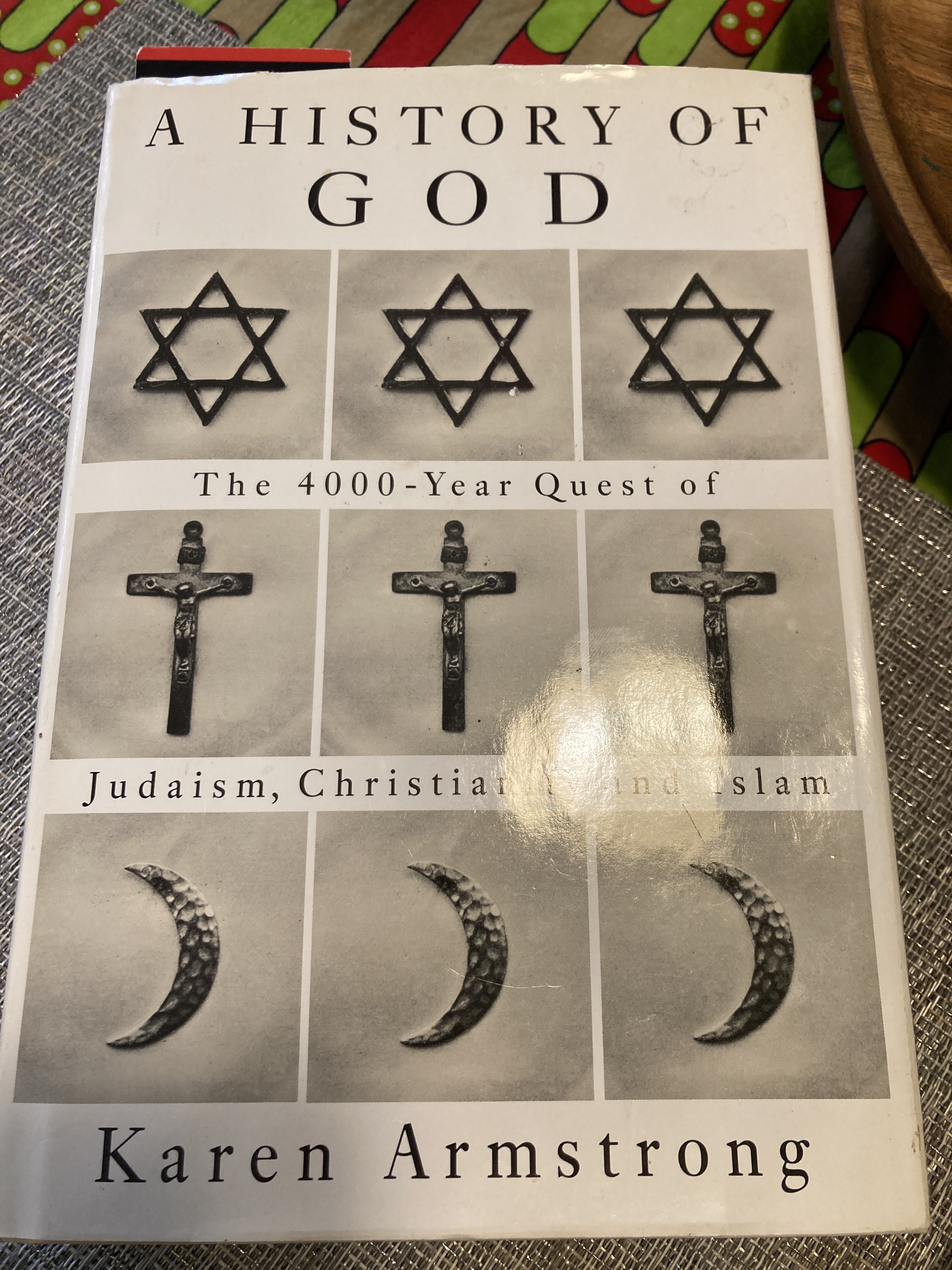
I commend Karen Armstrong for this massive effort of over 400 pages, covering 4000 years of history across broad swathes of the Middle East & Europe. My criticism is that–other than a few scant mentions of Vedic or Buddhist philosophy–the book took a fairly Eurocentric viewpoint. Even though the book focused on Abrahamic religions (Judaism, Christianity, and Islam), it did almost nothing to include the history of these traditions within Africa and the influence that African developments had on these three massive, overlapping global cultures.
That being said, what the book does, it does well. A thorough, exhaustive examination of the history of monotheism within Western civilization, it ventures from the days of Canaanite and Babylonian gods to the desert wanderings that bring forth the Israelites, the introduction of Greek and Roman ideas to the Hebrews, the development and expansion of Christianity, and the rise of Islam. Then, it goes on to examine the complex interactions between these three cultures (Judaism, Christianity, and Islam), and the further development of their philosophies through successive periods of history.
Armstrong is adept at bringing abstract and perplexing ideas about the nature of reality down to the level of simple understanding, with conversational language and historical context. Though I often disagreed with the author’s perspective, I found her explanation of the ideas crucially informative.
MESSAGE TO THE PEOPLE
BY MARCUS GARVEY

I first heard of Marcus Garvey in the Autobiography of Malcolm X, the subject of a 6th grade book report, where Malcolm speaks about his father’s work organizing on behalf of Garvey’s Universal Negro Improvement Association. I heard more about Marcus in 8th grade U.S. History class, and more still when I was older. In college, while I was struggling to decide on a major at the University of Washington, I listened to a public radio program about Garvey that emphasized his focus on economic development through grassroots business endeavors. As someone who always felt my life’s purpose would include the empowerment of the working class, I appreciated Garvey’s thesis and decided to major in Business Administration with a focus on Entrepreneurship.
I became much better acquainted with Marcus later in life, within the Rastafari movement. The teachings of the Right Honorable Marcus Mosiah Garvey–who some call Prophet, the returned John the Baptist, or even God in flesh–are central to the movement. Garvey’s prophecies and declarations are often repeated in Reggae music or Nyabinghi chants, and his way of thinking features heavily in Rastafari reasonings. The most familiar of Garvey’s works are his “Philosophy and Opinions”, published in two volumes by second his wife Amy Jacques Garvey, and his oft-quoted articles from the “Negro World” and the “Blackman”, two newspapers that he published in the early 20th century.
This book is lesser known, and rightly so, because it was never intended to be seen by anyone outside of the leadership of the UNIA organization. As such, it provides crucial insights into the deeper thoughts and motivations of Marcus Garvey, because unlike his other popular works it was never a public statement. On the one hand, it is shocking in its disgust and hatred of the White man. However, understanding that this was written in the time of Jim Crow segregation, South African apartheid, lynchings, and the Ku Klux Klan, I will allow him his anti-White vitriol. On the other hand, it is inspiring in its completely holistic vision of the elevation of the Black man, and the the thoroughly-considered program of self-improvement it lays out. I would thoroughly endorse this program for people of any race.
THE BLACK HISTORY BOOK
BY DK PUBLISHING
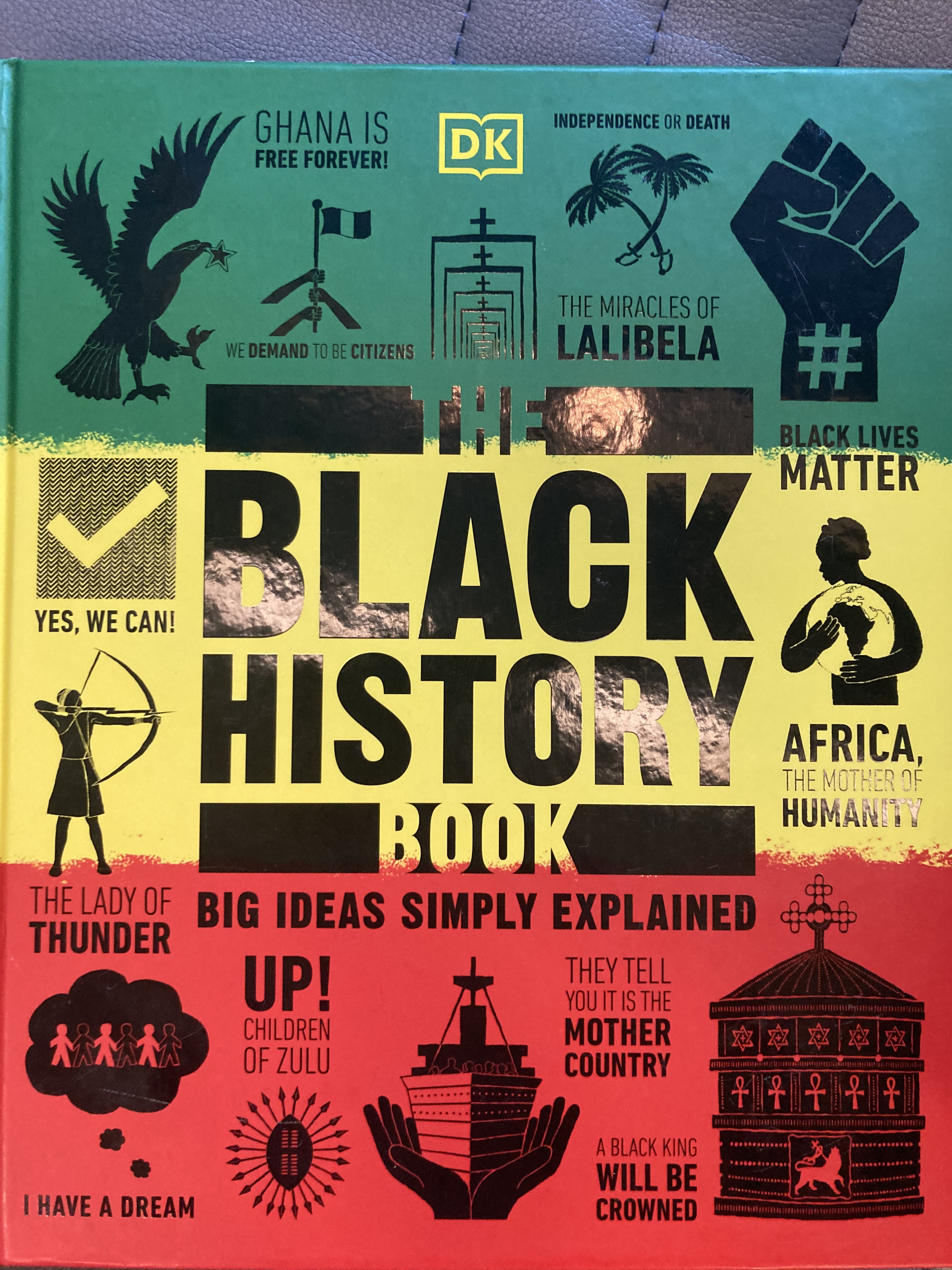
This one found me by accident. I was in Portland, Oregon, shopping at the famous Powell’s Books, looking for a wedding gift for Daghim. (I wrote about that in an earlier blog entry.) As Wende and I perused the “Africa” section, he picked this one up and leafed through it, but decided not to buy. I took a second look. I grew up loving these DK (Dorling Kindersley) illustrated reference books about everything from history to science, nature, and technology. So, this one was very intriguing and I bought it as a gift for my sons.
I haven’t read the entire book, to be honest, by I did sit down with it on a Saturday morning and leaf through the pages, pausing to read whatever jumped out to me as important. I was impressed by the thorough reporting and depth of historical data. While I did not agree with the political slant of much of the material, I was happy to see reference to many of the things that I hold dear, such as the ancient Ethiopian Orthodox Tewahedo Church, the coronation of Haile Selassie I, and the rise of the Rastafari Movement.
THE ETHIOPIAN TEWAHEDO CHURCH
BY ARCHBISHOP YESEHAQ

I have been searching for this one for years. This hard to find book was published in 1989 by Archbishop Yesehaq, the Archbishop of the Ethiopian Orthodox Tewahedo Church in the Western Hemisphere. The emissary of Haile Selassie I, sent to begin the Mission of the EOTC in the West, he is credited for establishing 70 churches and–along with the hundreds of priests serving under him– baptizing as many as 300,000 people in North & South America and the Caribbean. He is rightly called “The Apostle of the West”.
A crucial part of His Eminence’s work was the introduction of the ancient Christian faith of Ethiopia to the people of the West, especially those of the African Diaspora. In service of this cause, he was highly involved in both the Black Power movements and the Christian ecumenical movements. An active participant in the World Council of Churches, US Council of Churches, and Jamaican Council of Churches, he was also an avid student of the works of Marcus Garvey. When the Mission came to Jamaica in 1970, he made it his special task to develop relationships with the Rastafari, baptizing thousands of dreadlocked Rastafari (some say 20,000, others 50,000) within the decade.
This book is important, and much sought after, because it combines a detailed history of the Ethiopian Church from the days of the Old Testament, through the Christian era–surveying the wars with the Muslims and with the European Colonialists–all the way up to modern times, along with a summary of the Church’s current missions abroad, including histories of each place where the Church is present outside of Ethiopia. This section of the book goes into great detail on the Rastafari movement and the sometimes controversial relationship between the Rastafari and the Church.
As a Rastafari baptized into the EOTC, and an amateur historian, I long harbored a great desire to read this book. First editions often sell for $2000, $3000, or even $4000 online, but, as fate would have it, I found a used copy on eBay for $100 (it wasn’t in the greatest condition). When it arrived, I immediately began scanning the pages and sharing them with my Rastafari and Orthodox family around the world. Then, within 3 or 4 days o getting the physical copy, someone provided me a complete scan of the book and my own work of scanning was nullified. Now I was free to voraciously devour the contents in both print and digital formats. This book is highly recommended, wherever you may find it.
Scanned Books
FOUNTAINHEAD OF CIVILIZATION
BY ABBA L. MANDEFRO

Along with the scan of “The Ethiopian Tewahedo Church”, I was also provided a scan of this book, “The Ethiopian Orthodox Tewahedo Church and Its Activities in the West”, sometimes known simply as, “The Fountainhead of Civilization” by Abba L. Mandefro. Mendefro was the name of Archbishop Yesehaq before he was made Bishop, and this book was likewise the predecessor of the latter book. Published in 1971, it contains a brief overview of many of the same topics covered in the longer 1989 book, but it is not the same in detail.
This book places more emphasis on the ancientness and distinction of Ethiopian civilization, citing references from both Biblical scholars and scientific historians that credit the ancient Ethiopians as the fathers and mothers of all mankind. This book also gives more detail on the history of the Church in Jamaica, and the sometimes fruitful, sometimes fraught relationship with the Rastafarians, by directly reproducing newspaper articles from the period.
Here we learn that many Rastafarians longed for the Church to come to Jamaica, made requests for decades, embraced its arrival in 1970, and were baptized, becoming enthusiastic members, while others were opposed to the Church for their own reasons. We also learn that many in the Jamaican Christian society also supported the Church and its Mission to the West, while other Jamaican Christians opposed it due to its very association with the Rastas. The presence and legacy of the Ethiopian Orthodox Tewahedo Church in Jamaica is a complex topic to understand, but this book sheds a lot of light on the matter.
THE ETHIOPIAN ORTHODOX CHURCH
EDITORS AYMRO WONDMAGEGNEHU AND JOACHIM MOTOVU

Keeping up with the trend, here is another book on the Ethiopian Orthodox Church published in the late 20th century, and acquired in digital form this summer along with the others. This book was actually the first book about the Church, published by the Church, in the English language. As the notes at the front make clear, it was published by Haile Selassie I’s own printing press on behalf of the Ethiopian Church Mission that he founded in the 1960s, specifically to educate individuals in the West about the Ethiopian Orthodox Tewahedo Church.
Similarly to the previous two books, this volume goes into great detail on the history of the Church of the Apostles within Ethiopia, how the seeds were planted in Old Testament religious practices (Ethiopia having been a Jewish nation for 1000 years before Christ), and how this blossomed into its own unique national Church over the centuries. Unlike the previous two books, this one goes into much greater detail about the specific doctrines, beliefs, and practices of the Church.
If you are curious about any matter of Ethiopian Orthodox doctrine, from the use of the symbols of the Cross, to the role of Our Lady Maryam, the actual presence of the Eucharist, or the teachings regarding Christ’s Second Advent and the Final Judgment, this book makes it all completely clear in a format that is wholly endorsed by His Imperial Majesty Haile Selassie I.
Assorted Publications
RAS WORLD CALENDAR 2024-2025
FROM THE EMPRESS MENEN FOUNDATION

These Ras World calendars from the Empress Menen Foundation (based in Shashemane, Ethiopia) are a Rastafari institution. Many years ago, I remember getting them from Ras Scott of the Word Sound Power Collective, but I didn’t see one for nearly a decade before recently being introduced to Askale Selassie (I call her “Mama Askale”), the publisher, through our mutual connections in the Association of Rastafari Creatives (ARC), Nyahbinghi Order, and Ethiopian Orthodox Tewahedo Church. Now I receive a shipment from her every year.
This year, I took out an ad in the calendar for my fitness coaching business (Smart Fit & Clean) and to my surprise Mama Askale shipped me 10 calendars, rather than the 5 I’d paid for. This was an extra-special gift that I was able to pay forward by sharing them with the Rastafari shop owners in my area, making these educational calendars more widely available to Seattleites.
The calendars themselves span 16 months from September (time of the Ethiopian New Year) to December each year, and they are unique for their inclusion of Rastafari celebration dates (primarily made up of the Nyahbinghi Issembly days), along with official Ethiopian state holidays, Ethiopian Orthodox Church holy days, and the liberation days of African and African-Diaspora countries. Each month is also labeled with its 12 Tribes of Israel tribe name and color, as well as the Ethiopian-calendar month names. It is a thorough reckoning of significant dates for the Rastafari Movement. On the facing page (the top half of a hanging calendar) you also have photos and quotations of Haile Selassie I, along with history lessons or photographs of current events within the global Rastafari family. This makes it a valuable educational resource.
RASTAFARI
FROM THE NATIONAL MUSEUM JAMAICA EXHIBITION

This one I happened across as part of a fundraiser for Wisemind Publications. I didn’t know what I was buying until it arrived in the mail, but I was quite pleased. In 2007, the Smithsonian Institution in Washington D.C. mounted an exhibition called “Discovering Rastafari”, under the guidance of Jakes Homiak. In 2013, a portion of this exhibit traveled to Jamaica, where it was expanded with local resources and titled “Rastafari”. This booklet was the official publication of the National Museum Jamaica at the time of that exhibit.
It includes extensive scholarly articles on the Rastafari Movement’s history and current global manifestation, written by some of the most accomplished scholars in the movement, including Dr. Jahlani Niaah. There are also hundreds of gorgeous color images of the items in the exhibit, ranging from historical artifacts to current arts & crafts output. End Notes provide references for further study, and a complete catalog describes each item in the exhibit (even those not pictured). I learned much from reading this and I appreciate being able to share the visuals with my children.
Ebooks
SMART FIT & CLEAN PDF GUIDES
BY NIC NAKIS



This is kind of like cheating because I wrote these books… So, yes, I also read them (and re-read them, and re-read them) in the process of writing them, laying them out, and publishing them. In fact, I publish one ebook per month on a fitness topic. They are all collected on the Resources page of my coaching website.
These three were part of a series called “Three Big Solutions”, which lays out my vision of saving the world one healthy lifestyle at a time. The series explored the ideas of authenticity in fitness, vigorous living, and personalized nutrition as solutions to the problems that are making human beings fat, weak, and sick.
Subscribe to my email list to be one of the first to know when my next free guide is released.
WISEMIND PUBLICATIONS ANCIENT TESTIMONIES
BY RAS FLAKO TAFARI

Over the past year, I have produced 22 full audio books–along with several excerpts and alternate readings–aided by a fantastic group of readers from throughout the Rastafari global family. This is a significant fraction of Wisemind Publications’ total catalog of 90+ books containing valuable first-person oral histories from the forerunners of the Rastafari Movement in Jamaica, along with reprints of important historical documents pertaining to Haile Selassie I of Ethiopia and the Jamaican cultural and religious orders who have taken his pre-coronation name (Ras Tafari) as their own.
What have I most learned from reading and producing this series of audio books? That the Rastafari tradition is not, in fact, at all what it is perceived as being by mainstream society, and that said tradition is not being upheld in the fullness of integrity by today’s generation. On the first point, I would draw attention to the fact that Rastafari is portrayed in popular media as being a group of ignorant, backwards, primitive, and racist stoners who are either always Irie (the beach-boy Rasta) or always threatening (witness the bodycount of “Rastas” in Hollywood action movies). However, in fact, the Rastafari elders represent a highly-intelligent and well-informed group with their vision set on higher civilizational achievement for Africans and for all of humanity. On the next point, I’d mention that many of the younger generations have conflated “Rasta” with “Reggae” or “Stoner” or “Downtrodden” or “Racist” or any of many other common mis-identifications that have led to a dilution of the Movement and an impediment to it’s objectives. Reading these testimonies has made this all abundantly clear.
In-Progress
THE LAST 4 COMMANDMENTS
BY H.H. POPE SHENOUDA III

I was appointed a Sunday School teacher by accident, at the behest of priests and parents who felt that the children at church were more likely to listen to a good native English speaker. It certainly didn’t come naturally to me at first, but I have grown into the responsibility, and found that I am able to leverage some of my gifts towards connecting with these children in a meaningful and lasting way.
Since April of last year, I have been teaching the 10 Commandments, as illustrated by His Highness Pope Shenouda III of Alexandria, the 117th Patriarch of the Coptic Church, in this series of four books. I am on the last of the four now, which covers the final four commandments (you shall not commit adultery, you shall not steal, you shall not bear false witness, do not covet what is your neighbor’s).
These are important moral directives and the Patriarch gives excellent instruction on how to follow them in a Christian manner. This means that we do not follow them merely by the letter–interpreting them in a narrow fashion and imposing death as a punishment–but follow them by the spirit, interpreting them broadly, but centering forgiveness towards ourselves and others in the quest to become gradually perfected in God’s grace, as He has intended for humanity. Christianity is often misunderstood, but in it’s Orthodox form of practice, it is the medicine for humanity.
 Nic Nakis