More books, some totally new to me, some that I am re-reading, or have been working on for a while… Black history, Rastafari, Orthodox Christianity, and behavior change.
AMIABLE WITH BIG TEETH
By Claude McKay

This book came to me by way of Mulageta Haile, the Ethiopian historian we met in Jamaica on our tour of Ethiopian Orthodox Churches. He was looking for a reference from the book’s bibliography. Misunderstanding his intentions, I bought Mulugeta a brand new copy (of a book he already has in his personal library) and had it shipped to Jamaica. I also bought one for myself. His copy had not arrived by the time he left the island, but I hope it is in the hands of someone who will appreciate it.
Even though it’s a work of fiction, the scholars who unearthed this manuscript in the papers of one of McKay’s publishers did thorough research on all the factual references and historical analogs to persons, places, and events mentioned in the book. So, the bibliography serves as a useful guide to 1930s Harlem and the importance of Ethiopia in the minds and daily lives of Harlemites at the time.
It is a very interesting novel, not because of the depth of the characters’ internal lives, or the vivid world building–or any of several other reasons that a novel might be considered interesting–but because it is a sort of historical time-capsule for what a certain place and time was like. All the persons and events are caricatures of actual persons and events, so it gives you a window on what happened in Harlem during the Italian invasion of Ethiopia.
The main point that McKay tries to get across is that worthy causes often become lightning rods for the most unworthy sorts of actors: The scavengers, the agents provocateurs, the manipulative politicians, the demagogues and charlatans. In this case, he’s pointing at the Communists in Harlem in the 1930s, who exploited the cause of black liberation and black dignity, attempting to harness all that enthusiasm for their own cause and their own power.
THE RAPTURE
By Prince Robbo Tafari
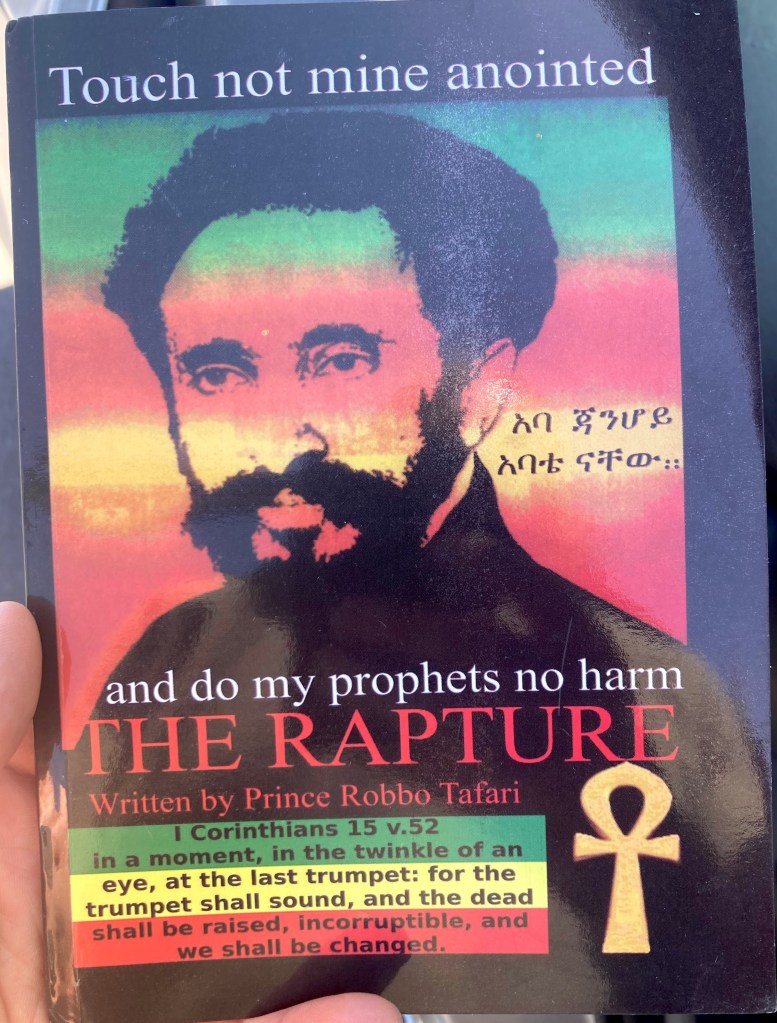
I was introduced to Ras Robbo by a mutual acquaintance of Jamaican origin who splits her time between England and Ethiopia, as the author does. I reasoned with the Rastaman over the phone and then I bought a copy of his book, several copies in fact.
Babylon tried to stop the first copy from reaching me, as the package from England was destroyed in shipping. I received a tattered, empty envelope and filed a missing package complaint with USPS, but the book was never found. So, he sent me another copy, this time direct from the printers in Addis Ababa, and it arrived within the week. A similar thing nearly happened when I ordered 10 copies to be sent to the Library in Mombasa: the Kenyan postal service tried to keep it from them. But, after the bredren in Kenya asked the right questions and paid some certain fees, they were able to liberate the books.
This is something rare, a book of Rastafari historical and Biblical interpretations written firsthand by a Rastafari elder, and not re-interpreted through the lens of academia, cultural anthropology, or the music press. Strongly reminiscent of The Promised Key by Leonard P. Howell, this book is a kind of stream of consciousness from an indigenous Rastafari, explaining his worldview completely, as it pertains to cosmology, philosophy, history, scripture, and current events, all with Haile Selassie I at the center.
As an insight into the mind of the traditional Rastafari, and particularly those of the Nyahbinghi Order, this book is essential.
ATOMIC HABITS
By James Clear
Something a bit less heavy than my typical reading. It’s not religion, not philosophy, and not history. Just a simple, light-hearted book about the practicalities of habit formation (and habit breaking). This one was recommended to be by a couple of my fitness coaching clients from Janicki Industries, where it seems to have done the rounds.
The book provides four “laws” for creating a good habit: 1) Make it Obvious, 2) Make it Attractive, 3)Make it Easy, and 4) Make it Satisfying
Likewise, it provides the inverse four “laws” for breaking a bad habit: 1) Make it Invisible, 2) Make it Unattractive, 3) Make it Difficult, and 4) Make it Unsatisfying
The writing style is engaging and convincing, with practical suggestions and activities to help apply the ideas in the book. The website also hosts a bunch of bonus materials and worksheets. I thoroughly enjoyed this book and found it highly useful in my work as a health & fitness coach, as well as in my own efforts to form and organize better sets of habits.
THE ORTHODOX WAY
By Bishop Kallistos Ware
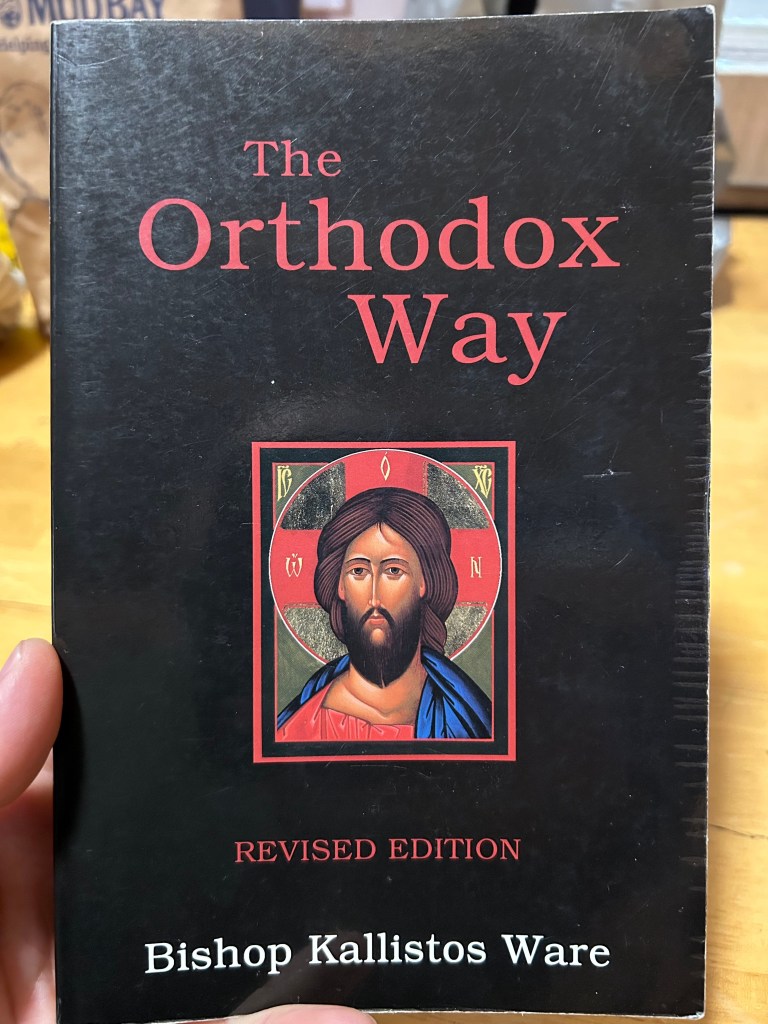
This was a cover to cover re-read of a fantastic book about Orthodox Christian spirituality. I was introduced to the writings of Bishop Kallistos Ware about 15 years ago by a very kind Deacon at the Greek Orthodox Church in Seattle (Deacon Perry at Saint Demetrios), who gifted me with a copy of “The Orthodox Church”. Unlike that book, however, this is not a history or explainer on Orthodox Christianity point-by-point. This is a tome of spiritual subjects, illuminated by the writings of the Saints.
Each topic, whether it covers the life of the Sacraments, or a Christian’s relationship with each particular member of the Holy Trinity, is written in such a way as to inspire devotion, deep insight, and inner spiritual development. I kept it by my bedside for a couple years, reading little bits here and there for an inspiration of introspection, or a reminder to pray.
There are six chapters: God as Mystery, God as Trinity, God as Creator, God as Man, God as Spirit, God as Prayer, and an epilogue: God as Eternity. I think it should be called, “The Christian Way”, because everyone who professes themself to be a Christian ought to think and live in this way that was taught to us by the Lord and His Apostles. But, I recognize that the term “Christian” has been co-opted and abused in this time, so it is just as well that we should use the moniker “Orthodox” for those who endeavor to live it in truth.
STOLEN LEGACY
By George G. M. James

As much as I wanted to believe it and wanted it to be true, it is actually pseudo-history. The basic premise that ancient Greek philosophers stole their knowledge from the Library of Alexandria and the Egyptian Mystery System is undermined by the historical timeline in the fact that Alexandria (and its library) were established BY the Greeks after their conquest, and likewise the Egyptian Mystery System has its start AFTER the Greek presence in Egypt.
Still, there is a seed of truth within the premise, and I perceive it is demonstrably true that the great civilizations of antiquity and the ancient world all sprung from the womb of what we now call Ancient Egypt. The Minoans, Greeks, Hebrews, Sumerians, Babylonians, Persians, you name it. They were all at one point or another tributaries to the Nile Valley civilization. They attributed their own roots to that place and credited it with originating the arts, sciences, and even the gods that they inherited.
As a piece of writing, however, this book is unpolished and unscholarly. The author repeats himself so frequently that it feels like you are actually reading multiple drafts of the same paper, smashed together and called a book. The references do not come from source texts, or from peer-reviewed journals, the works of eminent scholars–or whatever you would expect from a proper piece of philosophical history–but come from the sort of mass market reference books you find on coffee tables, and the writings of Freemasons. A powerful idea, an influential text, but ultimately not a good book.
THE BLACK HISTORY BOOK
DK Publishing

I’ve written about this book before, and I was pretty excited about it. But now that I’ve finished it cover to cover, I find myself disappointed by, and even opposed to this book. Yes, I learned a lot of new things about African history, and the history of black diasporas. If DK had settled on this being a kind of encyclopedia for these things, I guess I’d be happier with it. But, the authors and editors have chosen to portray a decidedly political, narrative version of history.
As a student of black history, I recognize that there is clearly a narrative thrust to be perceived in the history of a people once great, then crushed, then great again. Marcus Garvey put it best as, “Up ye mighty people!” But, the problem with this book is that it co-opts the energy of that massive collective upswell spearheaded by the great Pan-Africans, black Christians, and African Renaissance leaders like Marcus Garvey and Emperor Haile Selassie I, diminishing their particular roles in history, and bending the Black History narrative towards a Socialist and “Queer” political interpretation. (Shades of what McKay wrote about in “Amiable with Big Teeth.”)
The Directory of important black figures at the end of the book omits world leaders like Garvey and Selassie in favor of drag queens or athletes. The directory of black Movements neglects to mention either the Universal Negro Improvement Association or the Rastafari Movement–let alone the Organization of African Unity–but mentions Blaxploitation movies and Critical Race Theory. So they have co-opted Haile Selassie I’s flag colors and symbols, but they’ve sidelined his role in African liberation and unification. It’s like they want to steer the ship of black uprising away from the greatness that has been envisioned, and into the toxic culture of popular music, sexual excesses, and mere political protest.
 Nic Nakis